EUDI, Digital Wallets, and e-Boks: A new era of secure identity management
eIDAS 2.0 and EUDI Wallets will be the next central building blocks in Europe’s digital infrastructure. For businesses, this means new requirements, new opportunities, and a need to rethink how you work with identity, access, and credentials. On this page, you get an overview of what the changes mean in practice and how the e-Boks e-Wallet can help your organisation get started securely.
With eIDAS 2.0, the EU has decided that all Member States must offer at least one approved EUDI Wallet to citizens, residents, and businesses by 2026. The aim is to provide a common, secure solution for digital identity across borders, where users can identify themselves, sign, and share digital credentials while keeping full control of their own data.
Digital identity in Europe is on the verge of a shift. The EU has adopted new rules that will make it much easier and more secure for citizens to identify themselves, log in, and sign digitally across borders.
With eIDAS 2.0, the European digital identity wallet, often called a EUDI Wallet, becomes a central tool. All Member States must offer at least one approved digital identity wallet by 2026.
For businesses and institutions, this means that digital wallets for identity and credentials are no longer a futuristic concept. They will become part of everyday life in login flows, customer journeys, access control, and documentation.
This page gives you a complete overview of eIDAS 2.0, EUDI Wallets, and the e-Boks e-Wallet. It also shows how your organisation can make the most of the opportunities instead of focusing only on compliance.
The original eIDAS Regulation defined the framework for trust services and electronic identification in the EU. With eIDAS 2.0, the EU is taking the next step.
The new rules mean, among other things, that:
All EU countries must offer at least one approved digital identity wallet by 2026
European citizens must be able to use their wallet to identify themselves, log in, and sign digitally in both public and private services
The wallet must be able to hold different types of digital credentials, for example a digital driving licence, diploma, or other certificates
For organisations, this creates a single European framework for digital identity. It opens up new possibilities for better user experiences, stronger security, and more standardised processes across countries and systems.
From today’s solutions to EUDI Wallet and e-Wallet
| Process | Without EUDI Wallet and e-Wallet | With EUDI Wallet and e-Wallet |
| Login and access | Different logins per system. Users forget passwords. Manual resets and support. | Standardised login via a digital identity wallet. Fewer passwords. Less support. |
| Onboarding new users | Manual data entry. Upload of ID photos. Time-consuming checks. | Verified digital credentials can be shared directly from the wallet. Faster and more secure onboarding. |
| Age verification | Physical ID in store or unreliable self-declarations online. Risk of errors and fraud. | Digital proof of age is shared directly from the wallet. A clear yes/no on whether the user meets the age requirement. |
| Documentation and evidence | PDFs, images, and attachments stored in different places. Hard to keep track of. | Digital credentials are stored together in the wallet and can be shared and verified when needed. |
| User control of data | Limited insight into where data is used and who sees what. | Users have one place to manage their digital credentials and can choose what is shared in each situation. |
EUDI stands for European Digital Identity. A EUDI Wallet is the EU’s term for the digital identity wallet that meets the new requirements.
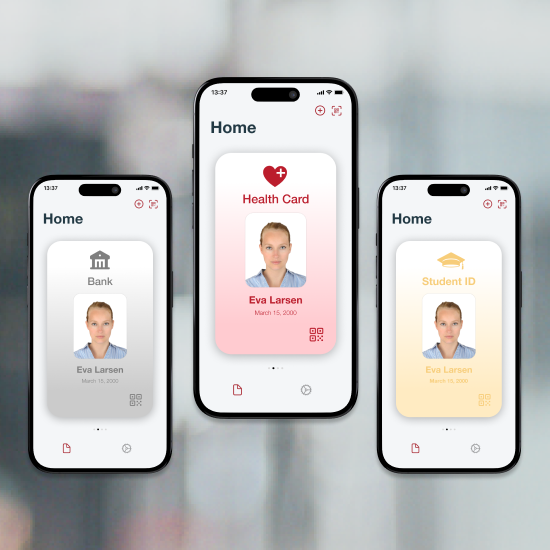
For citizens, a EUDI Wallet works as a secure digital place where they can store and manage their credentials. For example identity, proof of age, student ID, and other types of credentials.
From the perspective of a business or institution, a EUDI Wallet is:
A new way to identify users and customers digitally
A tool to reduce manual checks and physical ID
A way to raise the security level without making the user experience more cumbersome
A foundation for new digital services built on verified credentials rather than unverified information
Instead of having to build their own identity solutions, businesses can connect to a standardised wallet. This makes it easier to scale across countries and systems while meeting European requirements.
e-Wallet is e-Boks’ digital identity wallet that lets organisations request, receive, and validate verified credentials from users, while the EUDI Wallet is the EU’s overarching framework for approved digital identity wallets under eIDAS 2.0.
E-Wallet is e-Boks’ digital identity solution that enables businesses and institutions to verify user identities efficiently and securely.
The solution supports several types of digital ID data, including:
Digital student ID
Verified age information
Membership cards and other types of credentials
E-Wallet is designed to align with the European standards set out by eIDAS 2.0. Users keep control of their data. Organisations get an intuitive and standardised way to request and validate credentials.
Over time, the aim is for e-Wallet to be used to store and manage a wide range of digital identities and certificates that can be used across sectors and borders.
EIDAS 2.0 and EUDI Wallets are not only about regulation. They give different types of organisations a shared foundation for trusted digital identity and credentials. The value looks slightly different depending on whether you are an educational institution, a retailer, a financial institution, or a public authority.
The overview below shows how EUDI Wallet and the e-Boks e-Wallet support concrete objectives for key stakeholder groups.
| Stakeholder group | Key objectives and challenges | How EUDI Wallet and e-Wallet help |
| Educational institutions | Verify student status. Manage access to campus and exams. Reduce manual ID checks and cards. |
Issue digital student IDs as verifiable credentials. Use the wallet for access and identification on and off campus. |
| Retail, events, and the experience economy | Comply with age restrictions. Keep queues short. Offer smooth check-in and self-service. |
Use verified age attributes for quick age checks. Turn tickets and passes into wallet credentials that are easy to scan. |
| Financial services, insurance, and other regulated sectors | Strengthen KYC. Reduce fraud. Make onboarding and login more efficient without lowering assurance. |
Request and validate verified credentials instead of PDFs and manual uploads. Support secure login and signing with higher levels of assurance. |
| Public and semi-public services | Enable secure self-service. Reduce physical appointments. Build trust in digital channels. |
Accept reusable credentials across services and borders. Support digital applications and documentation based on verified data. |
Across all these groups, the pattern is the same. Instead of working with scattered logins, local ID checks, and manual documentation, organisations can plug into a standardised wallet. Citizens, customers, and students keep control of their own credentials while businesses and institutions gain a more secure, efficient, and scalable way to verify who they are dealing with.
To realise the next generation of digital identity, e-Boks has entered a strategic partnership with the start-up dewa.
Dewa was founded by two engineers with backgrounds from the Technical University of Denmark (DTU) and the Technical University of Munich (TUM). They have developed a digital identity wallet that is compatible with the European blockchain EBSI and designed to work across EU Member States. The solution gives users full control over their data and complies with EU regulations for security and privacy.
Together, dewa and e-Boks are launching e-Wallet. The goal is to combine:
Dewa’s technological expertise and focus on the next generation of digital identity
e-Boks’ many years of experience with secure digital communication, infrastructure, and relationships with both public and private organisations
The partnership enables e-Boks to issue digital credentials that can be used, for example, for age verification in online commerce, access to digital services, or identification in physical environments.
The Technical University of Denmark (DTU) is among the first to test e-Wallet in practice in a pilot project where students receive a digital student ID directly in the app. The project explores how a digital wallet can be used in everyday life for access to campus, exams, and other study-related services.
![]()
Lorenz FlechtenmacherCo-founder and CEO at dewa
“The most exciting part is how quickly real use cases appear once the foundation is in place. Verified student ID, age verification, secure credential sharing, and then step by step into more services. A wallet is more than storage. It is an ecosystem for issuing and verifying digital credentials, so trust can move with the user from service to service and from country to country.”
The possibilities for using digital identity wallets are broad. Here are some of the most obvious scenarios.
Issue digital student IDs to students
Use the wallet for access to campus, exams, and laboratories
Give partners and collaborators an easy way to recognise and validate student status
This reduces the need for physical cards and manual checks and supports a more digital student experience.
Verify age when purchasing age-restricted goods, both online and in store
Use the wallet for access to events, festivals, or concerts
Support self-service and automated check-in flows
E-Wallet can display verified age attributes and make it possible to move more processes into self-service without compromising security and responsibility.
Simplify customer onboarding by using verified credentials
Strengthen KYC processes with digital proofs instead of paper and manual uploads
Support secure login and signing with a higher level of assurance than traditional usernames and passwords
This provides better experiences for customers and more robust processes for the organisation.
Make it easier for citizens to access self-service, both nationally and across the EU
Support digital applications and documentation with verified credentials
Reduce the need for physical appointments and manual checks
When digital credentials are stored securely in a wallet, they can be reused across services without being compromised along the way.
When identity and credentials move into a digital wallet, security and privacy become crucial.
E-Wallet has been developed with a focus on:
Ensuring that users have full control over their data
Following European standards for security and data protection
Being able to operate across EU Member States in line with eIDAS 2.0
This means that organisations can build solutions on top of e-Wallet with confidence that the foundation meets key principles for data protection and digital identity.
For citizens, it means they can gather important digital credentials in one place and only share them when necessary and with clear transparency.
The transition to working with a EUDI Wallet and e-Wallet does not have to be a large and complex project from day one.
A typical journey might look like this:
1. Clarify your needs
Identify the flows where digital identity and credentials already play a role. For example onboarding, access, age checks, or discount schemes.
2. Choose relevant credentials
Define which types of digital credentials are most relevant to start with. This could be student IDs, membership cards, age ID, or access passes.
3. Pilot with a limited target group
Start with one institution, one chain, or one department. Test the user experience, integration, and operations before scaling up.
4. Scale and build further
Once the pilot is in place, the solution can be rolled out to more units, additional services, and new types of credentials.
e-Boks can help with advisory, architecture, and integration to ensure that e-Wallet fits into your existing systems and processes.
What is the difference between a EUDI Wallet and the e-Boks e-Wallet?
A EUDI Wallet is the EU’s term for a digital identity wallet that complies with eIDAS 2.0. E-Wallet is e-Boks’ concrete solution, designed to align with the European requirements and used in practice by citizens, businesses, and institutions.
Is e-Wallet the same as MitID?
No. MitID is a national solution for digital identification and login in Denmark. E-Wallet is a digital identity wallet that can hold and display different digital credentials and, over time, be used across the EU. The two solutions can complement each other.
When will EUDI Wallets become widespread in the EU?
EU countries are required to offer at least one digital identity wallet by 2026. The European Commission expects that up to 80 per cent of EU citizens will have access to a digital identity wallet by 2030.
Which sectors make the most sense to start in?
The most obvious sectors are education, retail, and events, where student IDs and age verification play a major role. In addition, financial services, insurance, and other regulated sectors have a strong incentive to use digital credentials in onboarding, login, and signing.
What does it require technically to get started with e-Wallet?
E-Wallet is built on open standards and APIs. This means that the solution can be integrated into existing systems such as portals, apps, and point-of-sale systems. The concrete implementation is adapted to your needs, your technical platform, and the flows you want to support.
eIDAS 2.0 and EUDI Wallets are not just new EU requirements. They are an opportunity to turn digital identity into an asset for your business.
With e-Wallet and the partnership between dewa and e-Boks, you get a Danish-developed solution that combines high security, usability, and European standardisation.
Would you like to learn more about how e-Wallet can be used in your organisation and how you can prepare for eIDAS 2.0 in practice? Then contact e-Boks today.