Nature still needs a helping hand
Even with rapid digitalisation, the pressure on ecosystems continues to grow. International reviews of global biodiversity efforts up to 2020 showed that the world fell short on most of its agreed nature targets, and deforestation and forest degradation remain serious problems in many regions.
The pulp and paper value chain is still a large industrial user of wood and water. Making, transporting and disposing of paper consumes resources and generates emissions, even when recycling systems are in place. When paper is replaced by secure digital communication in areas where it is no longer needed – salary slips, account statements, insurance letters, government decisions – there is a direct opportunity to ease that pressure.
In Denmark where more than 90% of the population uses e-Boks, and 95% prefer digital mail over physical mail, large senders have already reduced their paper volumes dramatically by shifting to digital distribution. For them, environmental savings now sit alongside cost, compliance and user experience as one of the core reasons to keep expanding digital channels.
EU Taxonomy, CSRD and the push for value-chain transparency
The EU Taxonomy for sustainable activities and the Corporate Sustainability Reporting Directive (CSRD) are raising the bar on how companies report environmental impacts across their full value chain. It is no longer enough to optimise within your own four walls. You also need to know how suppliers and key infrastructure partners – including digital platforms – contribute to your footprint.
For senders that use e-Boks as a Digital Postbox platform, this creates three opportunities:
Material footprint reduction
Moving from physical letters to digital documents reduces the material intensity of customer communication. Fewer tonnes of paper and lower transport needs make it easier to show progress against EU Taxonomy criteria for resource efficiency and pollution prevention.
Data for Scope 3 reporting
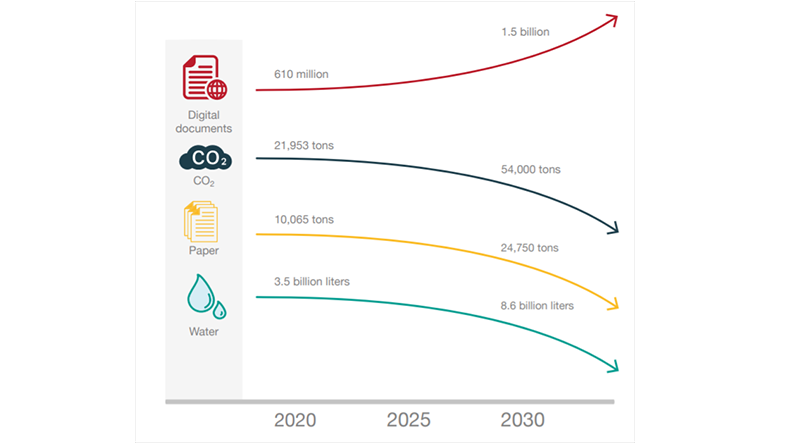
By tracking how many documents are sent and received digitally, senders can estimate avoided emissions compared to a paper-based baseline. e-Boks already helps larger clients with quarterly sustainability reporting that translates digital volumes into indicative savings on paper, water and CO₂.
Stronger documentation for regulators and investors
When digital post is part of a national infrastructure, it becomes easier to document that communication processes are reliable, secure and aligned with green transition policies. That matters both to regulators and to investors who look at digitalisation as an enabler for lower-carbon business models.
Greening the data behind secure digital communication
The environmental story of digitalisation is not only about replacing paper. It is also about the energy and emissions linked to data centres and networks.
In recent years, global attention has turned to the power use of data centres, especially those that support artificial intelligence workloads. Analysts now estimate that data infrastructure already accounts for a noticeable share of global electricity demand, and that AI-driven services are pushing this share upwards if nothing else changes.
This makes it even more important that core digital infrastructure is powered by cleaner energy. For e-Boks, this translates into three concrete ambitions:
Efficient by design
Our platforms are built to handle high document volumes with a relatively modest computing footprint compared to many consumer apps that stream or process large media files.
Partnering with greener data centres
In markets such as Northern Europe and Ireland, our data centre partners increasingly rely on renewable energy, for example through offshore wind and hydro-based electricity. Some of these partners have set their own targets to reach net-zero emissions by 2030.
Towards 100% climate-neutral data by 2030
Our goal is that, by 2030, the data behind e-Boks services should be delivered on climate-neutral infrastructure, in line with our commitments under the UN Global Compact and our Communication on Progress (COP) reporting.
In parallel, we continue to support reforestation efforts through our partnership with Trees for the Future, which plants trees in forest gardens run by smallholder farmers. This links our digital activities with very tangible, on-the-ground climate and livelihood benefits.
A practical path for companies and public authorities
For most organisations, the question is no longer whether digitalisation plays a role in their climate strategy, but how to do it in a way that is both credible and user-friendly. A secure Digital Postbox is one of the simplest places to start:
-
It replaces paper where that makes sense.
-
It gives citizens and customers a safer, more convenient way to receive and store important documents.
-
It generates the data needed to document progress on sustainability targets and regulatory requirements.
From there, organisations can expand into more advanced use cases – from digital consent flows and self-service to fully paperless onboarding – while keeping a clear view of the environmental impact.
To see how e-Boks works with climate, environment and responsible business in more detail, including our targets and performance, you can dive into our latest Communication on Progress (COP) 2024 report.